


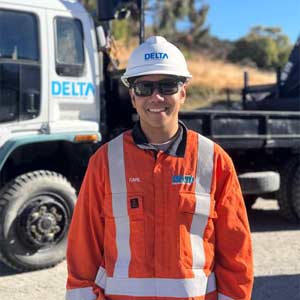
 Carl Michael Manglo is an electrical engineer and project manager in New Zealand’s power sector. After passing the board exams in the Philippines in 2011, he began his career in Singapore, working on nationwide fiber network installations. In 2016, he transitioned to New Zealand, joining Aurora Energy as a distribution design engineer. He handled 11kV and 33 kV networks, subdivision developments, and pole replacement programs.
Seeking a more hands-on role, he moved to Delta Utility Services, Aurora Energy’s primary contractor, where he designed and managed large-scale infrastructure projects. His expertise spans overhead-to-underground power conversions, large subdivision developments, and highvoltage network upgrades. Leadership in multi-milliondollar initiatives includes the Gibbston Valley conversion, The Arterials Project, The Lakeview subdivision, and the extensive Waka Kotahi Frankton Feeder Network relocation. A career built on technical expertise and execution continues to shape New Zealand’s evolving power distribution industry, ensuring reliable and efficient energy networks.
Ensuring Network Reliability Through Smart Planning
Balancing the technical aspects of distribution, design, and engineering with strategic project planning requires careful coordination. Every project must meet customer requirements while staying within budget and on schedule. Before starting a project, I ensure customers understand long lead items and explore alternatives. For example, if steel poles have long lead times, I calculate the strength equivalence and suggest using hardwood or concrete poles to keep the project on track. Queenstown’s power network operates under strict outage restrictions, especially during high demand in winter. Power cannot be shut off between June and August, so I plan to secure long-lead items at least three months in advance. Proper scheduling ensures projects are completed within these constraints.
“Balancing the technical aspects of distribution, design, and engineering with strategic project planning requires careful coordination. Every project must meet customer requirements while staying within budget and on schedule”
Technical knowledge plays a significant role in decision-making. My background in design engineering allows me to quickly assess and adjust plans on-site, whether installing a new power pole or transformer switch. Before finalizing changes, I consult lead and senior designers to ensure compliance with New Zealand standards. Network design engineers from Aurora also provide approval when necessary. Having technical expertise and project management skills allows me to deliver projects efficiently while maintaining network reliability.
Powering Through the Challenges
Many of my projects are in Central Otago, particularly in Queenstown, which presents challenges. One of the biggest is dealing with winter restrictions—power outages aren’t allowed during that time—scheduling becomes critical. Lambing and orchard season also play a big role. Building strong relationships is key. I always consult with the crew early in the design phase to identify potential challenges and come up with solutions. If a power outage is required, everything must be prepped for months to avoid delays. Coordination with the network is also essential before proceeding with any work.
Another challenge is working with local councils and contractors. Some areas require helicopters to install poles or string conductors over rivers and gullies. Using the right contractor for these situations makes a big difference. Older infrastructure adds another layer of complexity. Underground utilities installed decades ago often don’t have the clearances required today. Careful planning and backup strategies help navigate these issues. Keeping the team motivated also matters—long shifts in tough conditions aren’t easy, but a little appreciation, like coffee and scones, goes a long way.
Upgrading for Efficiency and Sustainability
Cable sizes have been increasing every year in Central Otago. When I started eight years ago, the 11 kV network used 120 mm² Al XLPE cable. That size increased to 185 mm² and now has reached 300 mm² for underground installations. The 33 kV cables followed a similar trend, moving from 95 mm² to 185 mm², then to 300 mm², and recently, I installed 630 mm² cables for the new Arrowtown #2 line project. Growth in demand has driven these changes, requiring higher capacity infrastructure.
Service boxes have also evolved. Older cylindrical boxes made isolation difficult, but cabinets now allow switching between transformers during faults, keeping the power on. High-traffic areas have also seen improvements, with service buses now flush with the ground to prevent damage. New Zealand’s push for a greener future has led to larger transformers. Previously, installations ranged from 100 kVA to 500 kVA, but now 1 MVA and even 1.5 MVA transformers are common. The rising need for EV chargers plays a big role in this shift. Seeing California’s extensive EV charging network was impressive, and New Zealand is working to expand its own to meet increasing demand.
Why Experience Beats the Textbook
When I graduated from university, I thought I knew everything. That was 15 years ago, and I quickly realized that real learning happens in the field. Theoretical knowledge provides a solid foundation, but hands-on experience truly shapes an engineer. Making mistakes is part of the process, and every challenge is an opportunity to grow. One of my early projects involved pulling a cable up a bridge with a tight bend. On paper, it seemed impossible, but the team on-site made it work. Designing in AutoCAD is one thing, but seeing how installations actually come together is a completely different experience. Earlier in my career, crews would joke that my designs were un-constructable, even though they followed New Zealand’s standards. Being on-site revealed challenges that weren’t obvious in the drawings, and working closely with the team helped me understand how to improve.
Learning from experienced crews and listening to their feedback made me a better designer and project manager. No one knows everything, so collaboration is key. Discussing things as a team leads to better solutions if they don’t go as planned. Aspiring engineers can take something from this approach.
