Utility
About UsConferencePartner With Us
  • Topics
    Compliance
    Gas Control
    Smart Grid
    Transmission and Distribution
    Utilities AI
    Utilities Asset Management
    Utilities Billing
    Waste Water Management
    Compliance
    Gas Control
    Smart Grid
    Transmission and Distribution
    Utilities AI
    Utilities Asset Management
    Utilities Billing
    Waste Water Management
  • Leadership Perspectives
  • Innovation Insights
  • News
×
#

Utilities Tech Outlook Weekly Brief

Be first to read the latest tech news, Industry Leader's Insights, and CIO interviews of medium and large enterprises exclusively from Utilities Tech Outlook

Subscribe

loading
THANK YOU FOR SUBSCRIBING

This article is part of Utilities Tech Outlook's Innovation Insights series featuring expert contributions nominated by our subscribers and reviewed by our editorial team.
Robert Koerner, WEHRLE-WERK AG | Utilities Tech Outlook | Top Waste Management Solution Companies in Europe

Resource Efficiency From Industrial Effluents

Robert Koerner , WEHRLE-WERK AG

Resource Recovery Authority

Editor’s Note: Industrial organizations face increasing pressure to improve resource efficiency while reducing environmental impact and meeting stricter sustainability expectations. This perspective is particularly relevant for utility, environmental and process industry professionals seeking practical approaches to extracting greater value from wastewater streams while advancing long-term sustainability goals.

Resource efficiency has become one of the buzzwords in industry. Newly designed products are lighter on materials and generate less problematic waste once they reach the end of their useful life. Within production, however, there are still often waste materials that need to be disposed of, ideally in a way that they can be reused, such as metals or paper. But what happens with industrial effluents? How can these be utilized?

Water is the number one solvent, used in many production facilities to wash out materials and substances. Be it in the pharmaceuticals industry, the cosmetics production, the food & beverage or the paper industry: clean water is ‘used’ in the production process. Depending on the local conditions and the level of pollution, it needs to be treated by the factory before it is discharged into the sewers as industrial effluent. Or, as the name suggests, as wastewater: What a waste!
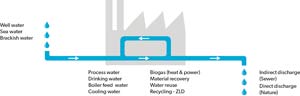
Even if the wastewater contents are of no value, there is still some potential. At the very least, this is the water itself.Many factory operators claim that the treated water is more expensive than fresh water and therefore reusing water does not pay off. Often it is overlooked, however, that the costs of treating water is incurred anyway. If the additional cost – if any – for bringing treated water up to the required quality for reuse is less than the cost of fresh water, it is obviously economical to recycle water, not to mention the reduced environmental impact associated with it. In addition, different production processes require different qualities of water and this does not always have to be fresh tap water.So, why not having a closer look into what water qualities are really needed and tuning the on-site wastewater treatment plant in a way that just the right water qualities are produced, cost efficiently?
It does not have to be Zero Liquid Discharge (ZLD) – another buzzword – the technology and expertise are there to implement a smart water utilization concept instead, that balances economy and ecology.
Beyond the mere water that can be reused, depending on the production process there is more potential that industrial effluents offer: Wastewater with high organic load, e.g. from food & beverage production, can be used to generate biogas that can be utilized in the factory to provide heat and electricity. This also has the side benefit of helping our climate by reducing greenhouse gas emissions by replacing fossil fuels. Some factories wash out substances of value with their wastewater. If recovered, these materials can be reused. In an example this is common salt, reducing the purchasing costs for it in a sugar factory on Mauritius by over 80%. In another example this is silver ions from the wastewater of the – still existing – analog film production in the UK, basically paying back the cost of the treatment plant in a matter of a few months only.

Of course, such solutions for ‘Smart Water Utilization’ do not come off the shelf. They require competence and experience, as well as the availability of suitable technologies and process combinations to get the job done – on an industrial scale. This means taking into account the special requirements of production facilities, such as frequent changes in wastewater composition and flow rate, but also the need for a modular treatment plant design to allow production to grow without the wastewater treatment plant becoming a bottleneck.
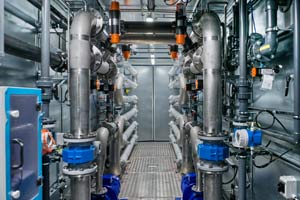
As an expert for the treatment of complex wastewater, the German plant constructor WEHRLE is not only known as global technology leader for the treatment of landfill leachate – the top class of wastewater treatment – but also offers turnkey solutions for industrial customers: From compact, space-saving effluent treatment up to complete industrial water management solutions and industrial effluent utilization, WEHRLE considers the conditions on site and the most economical combination of treatment technologies.

MORE FROM INNOVATION INSIGHTS

Top Business or Technology predictions for 2021
Cambridge Energy Solutions
Assef Zobian, Ph.D., President

Top Business or Technology predictions for 2021

Resource Efficiency From Industrial Effluents
WEHRLE-WERK AG
Robert Koerner

Resource Efficiency From Industrial Effluents

TEKNOFANGHI
Mr. Massimiliano Lagreca, Chairman

"Going global with sludge dewatering equipment"

Enabling Grid Transformation: How the CMC 500 Advances Protection Testing
OMICRON
OMICRON electronics GmbH

Enabling Grid Transformation: How the CMC 500 Advances Protection Testing


EXPLORE OUR KNOWLEDGE NETWORK


View Innovation InsightsRead Leadership Perspectives

The articles from these contributors are based on their personal expertise and viewpoints, and do not necessarily reflect the opinions of their employers or affiliated organizations.


I agree We use cookies on this website to enhance your user experience. By clicking any link on this page you are giving your consent for us to set cookies. More info

Utilities Tech Outlook APAC
Follow on LinkedIn

About

  • Home
  • About Us
  • Partner With Us

Stay Connected

  • Subscribe
  • Newsletter
  • Sitemap

Contact Us

  • editor@utilitiestechoutlook.com
  • sales@utilitiestechoutlook.com
  • marketing@utilitiestechoutlook.com

Legal

  • Editorial Policy
  • Privacy Policy
  • Terms of Use

© 2026 Utilities Tech Outlook APAC. All rights reserved. Headquartered in Fort Lauderdale, FL, USA.

This content is copyright protected

However, if you would like to share the information in this article, you may use the link below:

www.utilitiestechoutlookapac.com/innovation-insight/resource-efficiency-from-industrial-effluents-cid-295