Utility
About UsConferencePartner With Us
  • Topics
    Compliance
    Gas Control
    Smart Grid
    Transmission and Distribution
    Utilities AI
    Utilities Asset Management
    Utilities Billing
    Waste Water Management
    Compliance
    Gas Control
    Smart Grid
    Transmission and Distribution
    Utilities AI
    Utilities Asset Management
    Utilities Billing
    Waste Water Management
  • Leadership Perspectives
  • Innovation Insights
  • News
×
#

Utilities Tech Outlook Weekly Brief

Be first to read the latest tech news, Industry Leader's Insights, and CIO interviews of medium and large enterprises exclusively from Utilities Tech Outlook
Subscribe

loading
THANK YOU FOR SUBSCRIBING

Cambridge Energy Solutions has been recognized by Utilities Tech Outlook Magazine as the exclusive recipient of “ Top 10 Transmission And Distribution Consulting/Services Companies - 2020,” based on our proprietary methodology, reflecting its position in the industry, and is also named among “,” reflecting its broader leadership. This profile has been developed by the Utilities Tech Outlook research and editorial team based on insights from an interview with Assef Zobian, President.

Cambridge Energy Solutions
Untangling the Electrical Power Marketplace for All

Cambridge Energy Solutions: Untangling the Electrical Power Marketplace for All
Tweet

The production, storage and distribution of electricity is a complicated affair. First and foremost, it cannot be stored efficiently, and as such, to ensure consistent availability, electricity needs to be constantly produced fresh off a power plant. These plants rely on various resources that present their own sets of advantages and disadvantages. While nuclear and thermal sources are flexible in their operation cycles, they cost far more to set up. Solar and wind, on the other hand, require less capital investment but offer little to no flexibility in the amount electricity produced, or the reliable rate of production. As such, there are hundreds of different factors and millions of permutations and combinations for figuring out and managing energy production and distribution. In a nutshell, the economics of electricity generation depends heavily on installation and operational costs, and ability of the transmission grid to move power from sources to demand centers. Not all electricity is priced the same during all times of the day.

To ensure efficient delivery of electricity at a certain cost, electricity needs to be traded in administrated markets, operated by Independent System Operators (ISOs), and traded by independent/private stakeholders including power generators, power traders, plant builders, and even electric companies. In today’s deregulated electrical power marketplace, these stakeholders source electricity and then sell it to demand markets wholly or in part. The ability of a stakeholder to accurately monitor and forecast the predicted demand and generation contributes to how seamlessly they function and generate revenue. They need to be empowered with the insights necessary to facilitate short term trading and forecast the market fluctuations, inclement weather, power system outages or maintenance, and then quantify the impact of these variables on market clearing prices. Ultimately, this will help them make informed decisions with respect to energy trading. Having access to the right data means better and more efficient management of MWh on a consumer level, which will result in several million in MWh and hundreds of millions of dollars being saved.

Headquartered in Cambridge, MA, Cambridge Energy Solutions (CES) helps companies achieve this feat by offering better visibility and analysis of electrical network and market data. For instance, CES’ offering allows ISOs to focus on the finer details of the transmission network such as: how supply and demand interact in the presence of a non-switchable network, and how to interact with the system operator responsible for maintaining the network and distribution, identify the reliability of a network grid, and create an efficient electricity economy.

As Dr. Assef Zobian, President of CES, states, “Electric power cannot be stored efficiently, and hence, most of the power we consume must be produced instantaneously, utilizing the lowest cost sources first, irrespective of location, thus making its networks extremely mission-critical. The variation in consumption of power causes a variation in pricing. As demand increases at different locations, the generation must respond to meet that increase in demand dynamically, flowing on the transmission grid without harming it, and that sometimes creates a locational or system wide shortage or scarcity, and in turn, a high or low locational market price and volatility in the market.”

Subsequently, critical players in the electric power market ought to meet their two key objectives:

1. Maintain Reliable Power Delivery

2. Minimize Cost of Operation or Maximize revenues

CES helps their clients achieve this, with their flagship visibility and market simulation tool, DAYZER— Day-Ahead Locational Market Clearing Prices Analyzer.

DAYZER and TRANZER—the One-Two Power Analytics Combo

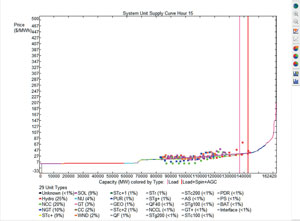
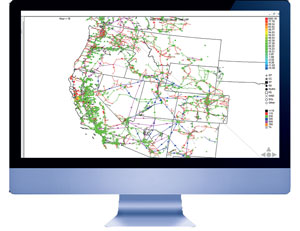
CES has developed DAYZER to assist electric power participants analyze the locational prices and the associated transmission congestion costs in competitive electricity markets. Using DAYZER algorithms as a core, CES has published models for each of the competitive electric markets in North America and some larger regions such as the WECC and currently for the CAISO, ERCOT, MISO, NEPOOL, NYISO, ONTARIO, PJM and SPP markets. CES has also published a combined models for neighboring markets, e.g. the PJM-MISO region. The models simulate the operation of the electricity markets by mimicking the market clearing mechanisms and dispatch procedures used by the corresponding ISOs and replicate their calculations in solving for the security-constrained, least-cost unit commitment and dispatch in the Day-Ahead markets.

DAYZER forecasts hourly locational market-clearing prices and congestion costs using the most recently available information on generator economics, fuel prices, demand forecast, generation units and transmission line outages, and emission permits costs, which are fully integrated into the DAYZER model and updated on CES servers on a monthly, daily, or hourly basis. The user can easily overwrite any of these assumptions.

Our clients need to be educated on how our software can help them, and secondly, how they can link it to the market for understanding it better and then interpret its impact

DAYZER incorporates all the security, reliability, economic, and engineering constraints on generation units and transmission system components. The tool can be easily modified to emulate the specific operation of any regional market and the dispatch or operating procedures adopted and used by various ISOs in the US or in any market in the world. As a front-facing operations tool for the market participants, the DAYZER product is supported by CES’s complementary solution TRANZER, which lends a more granular view of the electric power transmission system.

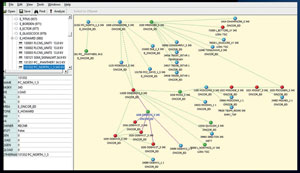
TRANZER is used to view, edit, and create Power Flow Data (PFD) stored in a backend database that represents an electric transmission system together with the additional network elements required for various physical and economic analyses. This additional data includes specifications for generation units and aggregate buses (zones and hubs) as well as phase angle regulators (PARs), AC and DC transmission lines, interfaces, and contingency constraints for analyzing the impact of the loss of system elements. TRANZER can also be used to analyze the transmission system, specifically calculating shift factors, loss factors, and power flows from a DC or AC perspective.

Transmission system data can be imported from other sources or created from scratch. Generation units, aggregate buses, PAR constraints, line constraints, interface constraints, and contingency constraints can be imported from CSV files or created interactively within the application by selecting elements of the transmission system. The application provides table-based reports for all transmission system data as well as system constraints, interface, and load or pricing aggregate definitions. The offering provides search capability for filtering large data tables, and reports pertaining to that data can be copied to MS Excel spreadsheets using normal clipboard operations. It is also capable of generating a graphical network diagram view of the neighborhood of the transmission system around a selected bus or generating unit, and building a one-line diagram to visualize power flows in a local area. These diagrams are fully interactive, allowing the user to navigate to transmission system data by selecting entities shown in the diagram. Finally, it has a direct interface with DAYZER that enables users to analyze the hourly output of DAYZER simulations in full detail with results for every bus and line in the system.

Helping the Whole Spectrum of Power Market Participants

CES’ software caters to the entire spectrum of electric power market participants, including ISOs interested in improving their internal processes. The software is also used by research universities and consulting firms for analyzing the impact of different public policy proposals, whether it is environmental, technical, or for measuring the impact of change in transmission systems configurations. CES also has clients that own electric power generation assets and use the software to optimize the operation of their assets and maximize their profits. Other users include load-serving entities that buy power from the market, such as electric power traders who trade power and provide market liquidity, price transparency for the futures market, and deliver hedging mechanisms for other market participants.

“We enjoy teaching, training and working with our clients to address and resolve their complex technical problems and implement workable solutions”

On another front, Electric power plant developers that want to develop new power plants—wind, onshore, solar or offshore wind—use CES software to analyze operation, revenues and congestion costs under different market conditions.
The solution offers a means for these developers to identify ideal locations for interconnection, the types of technology to use and also calculate the investment budgets.

DAYZER and TRANZER are also highly flexible, and they can meet different configurations for the installation of the software and set up, either on the cloud or on physical servers. CES also covers onboarding support, offering a helping hand to walk clients through the products’ application in the field. The company provides training, maintenance, and support of all its software products. These services are provided either remotely or on-site.

Supportive Service for Ideal Solution Delivery

The first step in CES’s onboarding services is education. As Dr. Zobian states, “Our clients need to be educated on how our software can help them, and secondly, how they can link it to the market for understanding the market clearance mechanisms better; to interpret the results from generation to distribution.

Clients are given a walkthrough of the products wherein CES describes the effect of incorporating sustainable energy resources’ outputs to the power grid. They also elucidate how the stress builds on the transmission systems, the system operators, and helps clients identify opportunities to invest t more on new systems and transmission lines capable of meeting higher demands. Here the values of the products are made abundantly clear. Users understand the solution and how detailed and accurate they are. Clients can ascertain the advantage of CES solutions. The solution is a customizable tool that can analyze anything from a high level, or from a simplistic point of view to highly specific. “We enjoy teaching, training and working with our clients to address and resolve their complex technical problems and implement workable solutions,” states Zobian.

The Road to the Future—A Unified and Simplified Energy Ecosystem

CES continuously strives to develop and adopt new technologies that can aid the implementation of solutions or create tools to forecast expected power market conditions and prices. The company currently owns detailed demand forecast models and wind and solar generation models that rely on sophisticated algorithms to forecast hourly generation for each power source, based on weather forecast data. These innovations are powered by scientists and engineers at CES, who enjoy solving novel and complex problems and developing tools that are useful and valuable to their clients. For nearly 17 years since its inception, CES has continuously added new tools and algorithms to improve their offerings and the company plans to develop new technologies as they go on. CES is currently at a turning point in an electrical power revolution—something that they are keen to leverage for the years to come.

Many testimonials speak to the efficacy of CES’ solution, with one client, Fredrick Ikugbagbe a Power Trader, stating:

"Dayzer is an efficient production cost model in analyzing the properties of the market system and processes used in clearing and pricing various energy markets. Its distinction is the flexibility it brings to the functional and technical requirements of the base implementation of a transmission topology consistent with the ISO's unified formulations, market algorithms and planning assumptions. I have utilized Dayzer in various forms fundamental analysis of congestion, generation and transmission expansion and reliability planning, etc..) however my best experience with the tool is the implementation of Nuclear Asset Rationalization in the energy market, while working for a large utility participating in the PJM market. Dayzer's flexibility (is second to none) in incorporating ISO's market assumptions to calculate the price impact of cycling nuclear units for congestion that leads to significant negative prices at the unit bus. The result of this project led to major changes in the ISO market methodology around nuclear assets. The initial project saved more than $80 Million, and since then saved the market more in congestion cost, reduced FTR underfunding and helped avoid early nuke retirement.I have used several production cost models in the last decade and I can say Dayzer offers the best prototype environment to simulate the ISO energy market operations."
- Olivia Smith
    June 29, 2020

Vendor Viewpoints

Top Business or Technology predictions for 2021

Assef Zobian, Ph.D., President
Top Business or Technology predictions for 2021
 Top 10 Transmission And Distribution Consulting/Services Companies - 2020

Company
Cambridge Energy Solutions

Management
Assef Zobian, President

Description
Cambridge Energy Solutions (CES-US) is a software company with a mission to develop software tools for participants in deregulated electric power markets. . CES has developed DAYZER to assist electric power participants analyze the locational prices and the associated transmission congestion costs in competitive electricity markets. Using DAYZER algorithms as a core, CES has published models for each of the competitive electric markets in North America and some larger regions such as the WECC and currently for the CAISO, ERCOT, MISO, NEPOOL, NYISO, ONTARIO, PJM and SPP markets. CES continuously strives to develop and adopt new technologies that can aid the implementation of solutions or create tools to forecast expected power market conditions and prices. CES’s complementary solution TRANZER, which lends a more granular view of the electric power transmission system. The company currently owns detailed demand forecast models and wind and solar generation models that rely on sophisticated algorithms to forecast hourly generation for each power source, based on weather forecast data


I agree We use cookies on this website to enhance your user experience. By clicking any link on this page you are giving your consent for us to set cookies. More info

Utilities Tech Outlook APAC
Follow on LinkedIn

About

  • Home
  • About Us
  • Partner With Us

Stay Connected

  • Subscribe
  • Newsletter
  • Sitemap

Contact Us

  • editor@utilitiestechoutlook.com
  • sales@utilitiestechoutlook.com
  • marketing@utilitiestechoutlook.com

Legal

  • Editorial Policy
  • Privacy Policy
  • Terms of Use

© 2026 Utilities Tech Outlook APAC. All rights reserved. Headquartered in Fort Lauderdale, FL, USA.

This content is copyright protected

However, if you would like to share the information in this article, you may use the link below:

www.utilitiestechoutlookapac.com/cambridge-energy-solutions