Utility
About UsConferencePartner With Us
  • Topics
    Compliance
    Gas Control
    Smart Grid
    Transmission and Distribution
    Utilities AI
    Utilities Asset Management
    Utilities Billing
    Waste Water Management
    Compliance
    Gas Control
    Smart Grid
    Transmission and Distribution
    Utilities AI
    Utilities Asset Management
    Utilities Billing
    Waste Water Management
  • Leadership Perspectives
  • Innovation Insights
  • News
×
#

Utilities Tech Outlook Weekly Brief

Be first to read the latest tech news, Industry Leader's Insights, and CIO interviews of medium and large enterprises exclusively from Utilities Tech Outlook

Subscribe

loading
THANK YOU FOR SUBSCRIBING

AllPaid has been recognized by Utilities Tech Outlook Magazine as “Utility and Sewer Payments Platform of the Year 2026,” based on our proprietary methodology, reflecting its position in the industry, and is also named among “Top Utilities Billing Companies,” reflecting its broader leadership. This profile has been developed by the Utilities Tech Outlook research and editorial team based on insights from an interview with Geoff Knapp, CEO.

AllPaid
Redefining Accountability in Government Payments

AllPaid: Redefining Accountability in Government Payments
Tweet

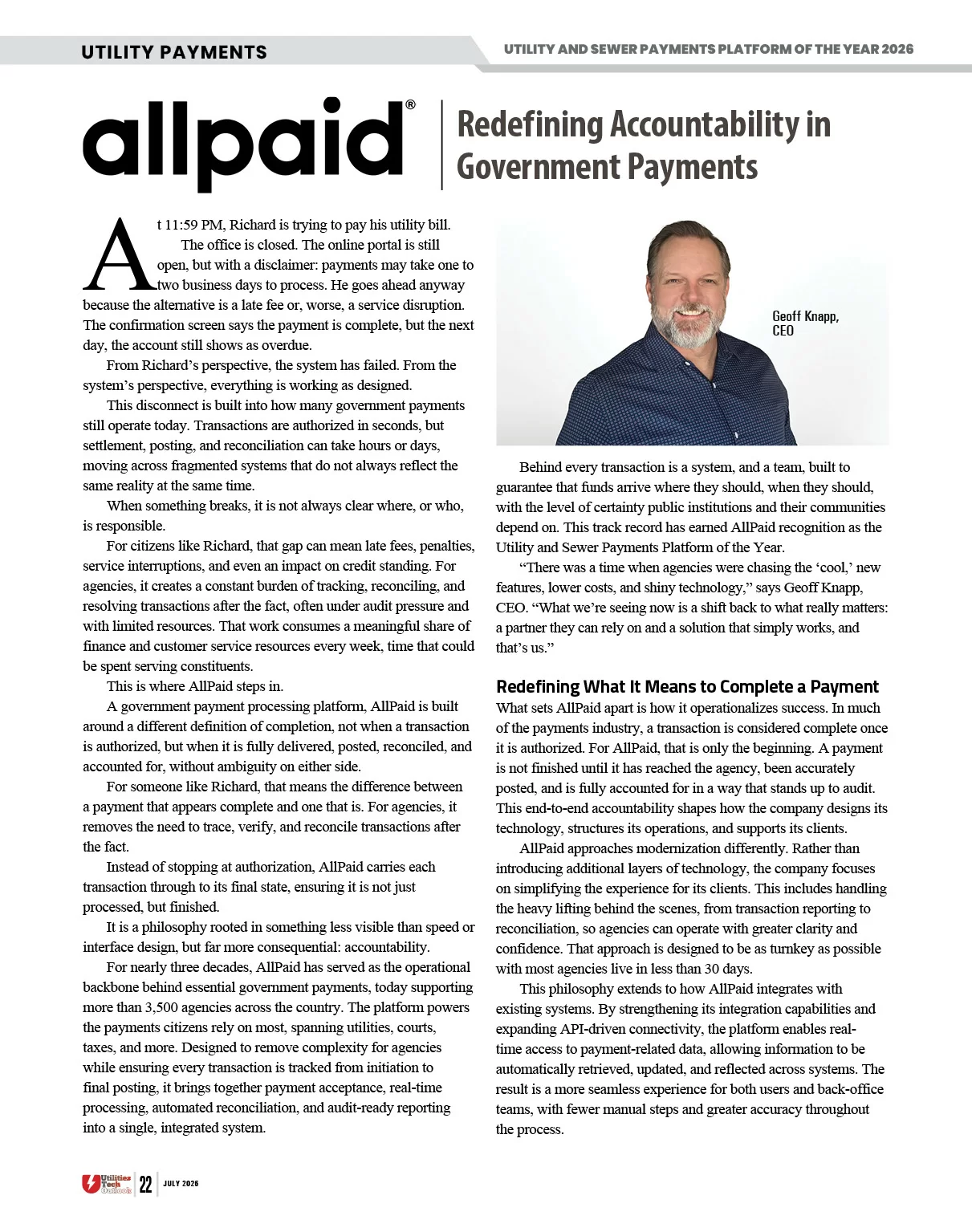
Geoff Knapp, AllPaid | Utilities Tech Outlook | Utility and Sewer Payments Platform of the YearGeoff Knapp, CEO
What operational gaps create confusion and delays in many government payment processing systems?

At 11:59 PM, Richard is trying to pay his utility bill.

The office is closed. The online portal is still open, but with a disclaimer: payments may take one to two business days to process. He goes ahead anyway because the alternative is a late fee or, worse, a service disruption. The confirmation screen says the payment is complete, but the next day, the account still shows as overdue.

From Richard’s perspective, the system has failed. From the system’s perspective, everything is working as designed.

This disconnect is built into how many government payments still operate today. Transactions are authorized in seconds, but settlement, posting, and reconciliation can take hours or days, moving across fragmented systems that do not always reflect the same reality at the same time.

When something breaks, it is not always clear where, or who, is responsible.

For citizens like Richard, that gap can mean late fees, penalties, service interruptions, and even an impact on credit standing. For agencies, it creates a constant burden of tracking, reconciling, and resolving transactions after the fact, often under audit pressure and with limited resources. That work consumes a meaningful share of finance and customer service resources every week, time that could be spent serving constituents.

This is where AllPaid steps in.

A government payment processing platform, AllPaid is built around a different definition of completion, not when a transaction is authorized, but when it is fully delivered, posted, reconciled, and accounted for, without ambiguity on either side.

For someone like Richard, that means the difference between a payment that appears complete and one that is. For agencies, it removes the need to trace, verify, and reconcile transactions after the fact.

Instead of stopping at authorization, AllPaid carries each transaction through to its final state, ensuring it is not just processed, but finished.

It is a philosophy rooted in something less visible than speed or interface design, but far more consequential: accountability.

For nearly three decades, AllPaid has served as the operational backbone behind essential government payments, today supporting more than 3,500 agencies across the country. The platform powers the payments citizens rely on most, spanning utilities, courts, taxes, and more. Designed to remove complexity for agencies while ensuring every transaction is tracked from initiation to final posting, it brings together payment acceptance, real-time processing, automated reconciliation, and audit-ready reporting into a single, integrated system.

Behind every transaction is a system, and a team, built to guarantee that funds arrive where they should, when they should, with the level of certainty public institutions and their communities depend on. This track record has earned AllPaid recognition as the Utility and Sewer Payments Platform of the Year.

“There was a time when agencies were chasing the ‘cool,’ new features, lower costs, and shiny technology,” says Geoff Knapp, CEO. “What we’re seeing now is a shift back to what really matters: a partner they can rely on and a solution that simply works, and that’s us.”

How does AllPaid extend payment processing beyond simple transaction authorization and acceptance workflows?

Redefining What It Means to Complete a Payment

What sets AllPaid apart is how it operationalizes success. In much of the payments industry, a transaction is considered complete once it is authorized. For AllPaid, that is only the beginning. A payment is not finished until it has reached the agency, been accurately posted, and is fully accounted for in a way that stands up to audit. This end-to-end accountability shapes how the company designs its technology, structures its operations, and supports its clients.

AllPaid approaches modernization differently. Rather than introducing additional layers of technology, the company focuses on simplifying the experience for its clients. This includes handling the heavy lifting behind the scenes, from transaction reporting to reconciliation, so agencies can operate with greater clarity and confidence. That approach is designed to be as turnkey as possible with most agencies live in less than 30 days.

This philosophy extends to how AllPaid integrates with existing systems. By strengthening its integration capabilities and expanding API-driven connectivity, the platform enables real-time access to payment-related data, allowing information to be automatically retrieved, updated, and reflected across systems. The result is a more seamless experience for both users and back-office teams, with fewer manual steps and greater accuracy throughout the process.

There was a time when agencies were chasing the ‘cool’, new features, lower costs, shiny technology. What we’re seeing now is a shift back to what really matters: a partner they can rely on and a solution that simply works, and that’s us.

As a result, agencies no longer need to manage multiple vendors, chase discrepancies, or manually reconcile transactions. Instead, they can rely on a system designed to handle complexity on their behalf.

The impact is both operational and cultural. When systems work as expected, teams are no longer stuck in a cycle of troubleshooting and reactive fixes. Instead, they can shift their focus toward planning, improving services, and better supporting their communities.

Why is reducing payment workflow friction important for agencies and constituent service experiences?

From Fragmentation to Flow

One of the most common friction points in government payment workflows is the moment a constituent has to enter the amount they owe. They have to find a paper bill or call the agency to confirm the balance, all before they complete a single payment. Each extra step is a chance for error, abandonment, or a follow-up call to the agency.

AllPaid recently deployed an integration for a public-sector agency that removes that step entirely. By connecting directly to the agency's system of record through an expanded API, the platform now looks up the amount owed in real time and pre-populates it on the payment screen. The constituent enters a single piece of identifying information, and the correct balance appears automatically.

The same capability extends naturally to utility billing. No hunting for a paper bill, no guessing at the amount, no underpayments or overpayments to reconcile later. For agencies, the operational impact is significant: shorter calls, fewer errors, and faster reconciliation on the back end. The change is largely invisible to the user, but it represents the kind of behind-the-scenes improvement that defines AllPaid's approach to modernization.

Technology Backed by Real Human Support

In an era where automation often replaces human interaction, AllPaid takes a more balanced approach. Technology, in this model, is not a substitute for human support; it is an enabler of it.

In a category where most competitors compete on flashy features and modern interfaces, support is often where the experience quietly breaks down. Agencies find themselves routed through call trees, waiting on tickets, or working with representatives who don't understand the realities of government payment workflows. AllPaid built its model around the opposite premise.

The company prioritizes direct, accessible support from people who understand the complexities of government payment systems. That support extends to both sides of every transaction. Agencies get a partner who understands their workflows, their audit requirements, and the systems they operate in. Constituents like Richard, the citizen paying a utility bill at 11:59 PM, get a real person on the other end of the line when something goes wrong, not a queue or a chatbot.

Government payments don't run on a 9-to-5 schedule. A late-night utility payment, a weekend court fine, a tax deadline at the end of the month, these are the moments when something can go wrong, and the moments when access to a real person matters most. AllPaid staffs its support function 24/7 for exactly that reason. Whether it's the middle of the night or a holiday weekend, constituents reach someone who can help.

The result is reflected in customer behavior. AllPaid's average customer relationship runs nearly a decade, and rarely a week passes without a note from an agency thanking the team behind the platform. For public institutions handling revenue they cannot afford to lose visibility into, and for the constituents who depend on those services, that kind of trust is built one interaction at a time.

Building Confidence Through Transparency and Trust

To what extent do transparency and accountability strengthen long-term government payment system reliability?

Beyond processing payments, AllPaid plays a critical role in helping agencies meet compliance and audit requirements. Every transaction is fully traceable, with detailed reporting available on demand. The platform is PCI DSS Level 1 certified and maintains SOC 2 Type II certifications, the standards government finance and IT teams require for any system handling public funds. This level of transparency allows agencies to operate with confidence, knowing they are prepared for audits and regulatory scrutiny.

That accountability extends to financial risk. AllPaid assumes chargeback liability on every transaction it processes, a position few platforms in the space are willing to take. For agencies, it means disputed payments don't become a back-office burden or a budget line item. The risk sits with AllPaid, not the agency.

In many cases, agencies that have explored lower-cost or feature-driven alternatives ultimately return, recognizing that reliability and accountability carry greater long-term value.

A Purpose-Driven Approach to Innovation

Looking ahead, AllPaid continues to evolve its platform with a clear guiding principle: innovation should reduce friction, not create it.

This includes expanding mobile capabilities to meet growing user expectations, strengthening integration layers to support increasingly complex ecosystems, and exploring ways to deliver actionable insights from payment data. At the same time, AllPaid continues to bring together a wide range of government payment use cases, from utilities to courts to taxes, into a single, cohesive system. This consolidation reduces vendor fragmentation and simplifies operations for agencies managing multiple services.

“Our goal is not to introduce change for its own sake, but to deliver improvements that agencies can adopt quickly and benefit from immediately,” says Knapp.

At a time when public sector organizations are under increasing pressure to do more with less, this approach positions AllPaid as more than a technology provider. It becomes a partner aligned with the realities of government operations, focused on delivering outcomes that are practical, reliable, and built to last.

Deep Dive

Accountability at the Core of Utility Payment Platforms

Utility and sewer payment platforms sit at a critical intersection between public agencies and the communities they serve. These systems are not judged by feature depth or interface novelty but by their ability to ensure that every transaction completes its full journey, from initiation to confirmed posting. Executives evaluating such platforms face a landscape shaped by fragmented legacy systems, increasing constituent expectations for real-time access and rising scrutiny around financial transparency. Many agencies still operate across disconnected payment channels, reconciliation processes and reporting systems. This fragmentation creates a persistent burden on internal teams, who must manually verify transactions, resolve discrepancies and respond to audit demands under tight timelines. The result is not just inefficiency but a gradual erosion of confidence, both internally and among constituents who depend on timely confirmation of payments tied to essential services. A missed or delayed posting is not a minor inconvenience; it can directly impact service continuity and public trust. In this environment, the defining characteristic of a credible platform is its ability to extend responsibility beyond transaction authorization. A payment is only complete when funds are delivered, recorded accurately and reflected in agency systems without additional intervention. Platforms that treat authorization as the endpoint often leave agencies exposed to reconciliation gaps and audit risks. In contrast, systems that embed end-to-end accountability create a foundation where agencies can operate with certainty rather than constant verification. Equally important is the removal of operational complexity. Agencies benefit from platforms that absorb the burden of integration, reporting and data management, allowing internal teams to shift focus from troubleshooting to service delivery. A simplified experience does not imply reduced capability; it reflects a deliberate design choice to handle complexity behind the scenes. This approach enables agencies to move away from reactive problem-solving and toward forward planning, supported by consistent and reliable transaction flows. Human accessibility remains another distinguishing factor. Automation can streamline workflows, yet it cannot fully replace the need for direct support in moments of urgency or ambiguity. Systems that prioritize immediate access to knowledgeable support, rather than layered escalation paths, reinforce confidence among both agency staff and constituents. This balance between automation and human responsiveness ensures that efficiency gains do not come at the expense of accountability. Finally, transparency underpins long-term trust. Platforms must provide clear, traceable records for every transaction, with reporting that is readily accessible for audits or internal review. When agencies can rely on complete, pre-structured data rather than assembling it under pressure, financial oversight becomes a continuous state rather than a reactive exercise. This shift strengthens both compliance and decision-making, allowing leadership to act with clarity rather than uncertainty. AllPaid aligns closely with these expectations through a model built on sustained accountability rather than feature-driven differentiation. It focuses on ensuring that each transaction is carried through to confirmed delivery and reconciliation, supported by systems designed to document and trace every movement of funds. Its approach emphasizes reducing agency workload by managing reporting, integration and back-office processes within a unified structure. It also maintains direct human support alongside its technology, ensuring that assistance is available when needed without delay. This combination positions it as a dependable option for agencies that prioritize consistency, transparency and long-term trust over short-term optimization. ...Read more
Utility and Sewer Payments Platform of the Year 2026

Company
AllPaid

Management
Geoff Knapp, CEO

Description
AllPaid is a government payment platform that enables agencies to securely collect and manage transactions across utilities, courts, taxes, and more. With a focus on end-to-end accountability, it ensures every payment is delivered, reconciled, and audit-ready, helping public institutions operate with confidence and efficiency.

I agree We use cookies on this website to enhance your user experience. By clicking any link on this page you are giving your consent for us to set cookies. More info

Utilities Tech Outlook APAC
Follow on LinkedIn

About

  • Home
  • About Us
  • Partner With Us

Stay Connected

  • Subscribe
  • Newsletter
  • Sitemap

Contact Us

  • editor@utilitiestechoutlook.com
  • sales@utilitiestechoutlook.com
  • marketing@utilitiestechoutlook.com

Legal

  • Editorial Policy
  • Privacy Policy
  • Terms of Use

© 2026 Utilities Tech Outlook APAC. All rights reserved. Headquartered in Fort Lauderdale, FL, USA.

This content is copyright protected

However, if you would like to share the information in this article, you may use the link below:

www.utilitiestechoutlookapac.com/allpaid-2026